
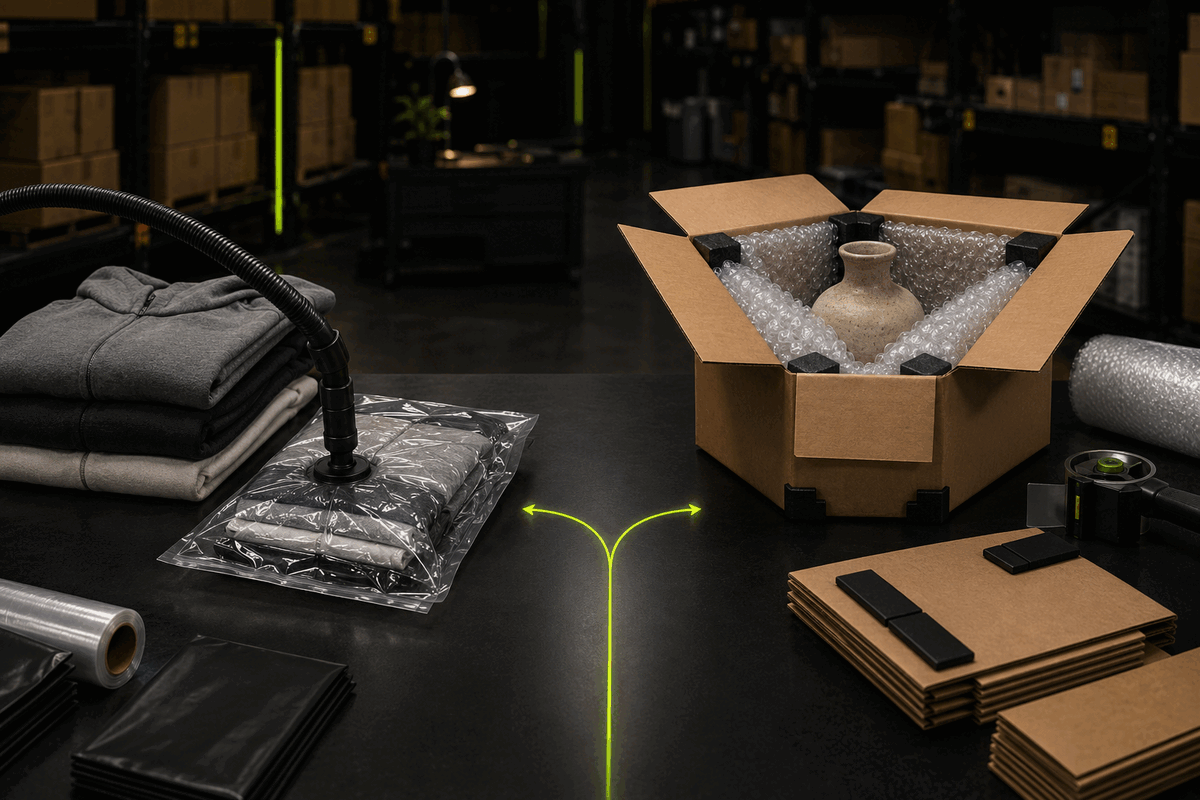
The smallest parcel is not automatically the safest parcel
Packaging decisions become expensive when they are made as one vague instruction for an entire haul. “Make it smaller” sounds sensible until a rigid box crushes a soft item or a fragile object loses the empty space that had been protecting it. “Add more protection” sounds safe until unnecessary volume changes the way a shipping method calculates the parcel. A useful plan begins by separating compression from protection.
CSSBuy publicly describes vacuum packaging as a way to reduce volume weight when a parcel contains many clothes. It separately describes reinforced packaging for fragile goods, using bubble film to protect items from damage to some extent. That final qualification matters. Reinforcement is risk reduction, not a guarantee, and vacuum packing is a volume-control technique, not a universal upgrade.
The practical question is therefore not “Which option is best?” It is “Which physical problem does each item create?” Soft textiles may hold removable air. A ceramic accessory may need cushioning and separation. Shoes may depend on structure. A mixed parcel may need two treatments inside one outer carton. Decide at item level before asking the warehouse to act.
Build a packaging map from physical behavior
Open your stored-item list and classify each product by what could happen under pressure. Use four working groups: compressible, rigid, fragile and uncertain. Compressible goods include many soft garments that can release trapped air. Rigid goods keep their shape and may press against nearby items. Fragile goods can crack, chip or deform. Uncertain goods have hidden construction or packaging that cannot be judged confidently from the listing alone.
This is a buyer's planning framework, not a CSSBuy status system. Its value is that it forces a specific instruction. A cotton T-shirt and a padded jacket are both clothing, yet they respond differently to compression. A soft cap may lose its crown shape. A collectible box may be physically rigid but valuable because of its condition. Write down what must survive, not only what the item is called.
Use warehouse photos to confirm visible shape, quantity and existing protection. CSSBuy says its QC service can take item photos and can assist with returning faulty products. Photos help you spot a damaged corner or an unexpected glass component, but they do not prove how every material will react when compressed. If the protection need remains unclear, ask through the relevant order record before building the parcel.
Compress air-filled textiles, not everything labeled clothing
Vacuum packaging is most credible when the problem is trapped air in a group of soft goods. CSSBuy explains that express delivery may calculate volumetric weight and presents vacuum packaging as a way to reduce parcel volume for clothing-heavy shipments. Its calculator also asks for length, width and height because volume can affect shipping calculations. This supports a clear goal: reduce avoidable bulk while preserving items that rely on shape.
Create a “vacuum approved” list rather than a blanket request. Ordinary T-shirts, flexible sweatshirts and similar soft pieces may be candidates. Exclude anything whose form matters to you: structured hats, delicate trims, rigid inserts, display packaging, or items you are not willing to receive creased. These examples are judgment criteria, not claims about a platform restriction. The buyer owns the preference and should state it.
Do not predict a fixed saving. The effect depends on the original air volume, the packed dimensions and the billing rule of an available route. CSSBuy's calculator notes that many lines compare actual and volumetric weight, while some lines calculate on actual weight. A smaller carton can matter greatly in one scenario and make little difference in another. Measure the outcome after packing instead of advertising a percentage before it happens.
Protect the failure point you can actually describe
“Fragile” is a warning, not a packing specification. Identify the failure point: a glass surface could crack, a ceramic edge could chip, a rigid product could be scratched, or a presentation box could be crushed. CSSBuy's public Ship For Me page says buyers should tell the warehouse about fragile items and that bubble film can be used as reinforced packaging. Turn that general service into a precise note tied to the correct stored item.
Ask for separation where contact is the risk. Ask for cushioning where impact is the risk. If the retail box itself matters, state that condition rather than assuming staff know it has collector value. If the item contains a transport-sensitive component, packaging does not change that attribute. A battery, liquid, magnetic component or perfume remains what it is after bubble wrapping and must still be matched to an eligible method.
Extra protection can add material and may affect final dimensions or weight. That does not make reinforcement a mistake; it means cost and protection should be evaluated together. Use the cost calculator as a planning tool, with honest dimensions and commodity attributes, then treat the warehouse-packed parcel as the operational result. Never remove protection solely to reproduce an earlier estimate.
Design zones before consolidating the haul
CSSBuy offers package consolidation, combining separate warehouse packages into a larger parcel. Consolidation can reduce duplicated outer packaging, but it also places products with different physical needs together. Sketch the final carton as zones: compressed soft goods, a protected rigid core and any shape-sensitive items kept away from pressure. The sketch can be a simple list; the point is to expose conflicts before submission.
Run both scenarios through the same decision sequence: correct destination, realistic weight and dimensions, accurate commodity attributes, eligible methods, then estimated cost. CSSBuy's calculator displays method characteristics, restrictions and size limits alongside estimates. A plan is credible only if the selected method can accept the actual mixture. Packaging should support an eligible shipment, not be used to disguise what the parcel contains.
A warehouse note should name the item, action and boundary
CSSBuy tells users that labels can be cut and invoices discarded when a note is left. It also asks customers to communicate fragile-item needs. These are action-based requests, so write them as a short checklist. Identify the stored item or order, state the requested treatment, and add what must not be changed. Avoid storytelling and avoid contradictions such as asking to keep every retail box while also demanding the smallest possible parcel.
A practical note might separate instructions into three lines: vacuum-pack only the listed soft garments; keep the named shape-sensitive item uncompressed; reinforce the identified fragile object with protective material. If you want a label removed or an invoice discarded, specify the relevant item and document. Do not turn that option into a claim that customs outcomes are guaranteed. Customs rules and decisions are outside a packing note.
Use the right record for the question. CSSBuy directs purchase, inspection, return and refund questions to Add Note on the relevant order. It directs tracking, logistics updates and parcel-detail questions to Add Note on the relevant parcel. Before submission, resolve item uncertainty on the order. After a parcel exists, keep parcel-specific packaging or logistics communication attached to that parcel where the interface allows.
Compare the packed parcel with the plan, not with a wish
Record a baseline before submission: selected items, requested treatment, expected destination and the rough weight and dimensions used for planning. Once the parcel is processed, compare the available package information with that baseline. Your first question is whether the instruction was applied to the correct items. Your second is whether the resulting parcel still suits the chosen method and budget.
CSSBuy's Buy For Me workflow separates the international shipping deposit from the later verification of parcel size and weight by the shipping company. Its calculator calls the result an estimate. Keep those stages separate. A pre-purchase number is a planning model; the parcel deposit is part of submission; the verified package produces the later operational charge. Do not accuse the packaging of “adding a fee” merely because an early estimate changed.
Packaging questions need item-specific answers
Should every clothing haul use vacuum packaging?
No. CSSBuy presents vacuum packing for reducing clothing volume, but individual garments may have shape, trims or packaging you want preserved. Approve only the items you accept compressing.
Does vacuum packaging guarantee a cheaper shipment?
No. It may reduce dimensions, but the effect depends on the packed parcel and the billing method of an eligible route. Compare the actual result rather than assuming a fixed saving.
Is bubble film enough for every fragile product?
CSSBuy describes bubble film as protection to some extent, not a damage guarantee. Identify the vulnerable surface or edge and decide whether the item belongs in the same parcel as heavy or rigid goods.
Can I vacuum-pack clothes and reinforce a fragile item together?
Those treatments can address different items in one plan. Give separate item-level instructions and assess whether consolidation still produces a sensible shape, weight and eligible route.
Will removing a label or invoice prevent customs issues?
No such outcome should be promised. CSSBuy states that these actions can be requested by note, but packing changes do not control the destination authority's decisions or legal requirements.
When should I send the instruction?
Prepare it before parcel submission and resolve any item uncertainty while the goods remain connected to their order records. After submission, keep parcel-specific questions with the relevant parcel.
Send one instruction set that a packer can execute
First, mark every item compressible, rigid, fragile or uncertain. Resolve uncertainty before parcel submission, and remember that protective material never converts a restricted attribute into ordinary goods.
Second, choose a treatment. Put only approved soft textiles on the vacuum list. Name fragile objects and their failure points on the reinforcement list. Record any shape-sensitive goods, retail boxes, labels or documents that must be kept or handled separately. Then decide whether consolidation or two parcels creates the more coherent physical plan.
Third, test the scenario with realistic weight, dimensions, destination and attributes. Compare eligible methods and their characteristics, remembering that the calculator is an estimate. Submit concise notes with item identifiers, positive actions and clear exclusions. Save the instruction and the pre-submission baseline.
Finally, verify the processed parcel before treating the task as complete. Check that the right goods received the right treatment and that the final package remains compatible with the selected method. Packaging is not a decorative extra at the end of buying. It is the last controlled decision between warehouse evidence and international handling, and it works best when every sentence tells the packer exactly what to protect, compress or leave alone.